Showing posts with label VSTi. Show all posts

Image.Line.DirectWave.v1.4.3-UNION


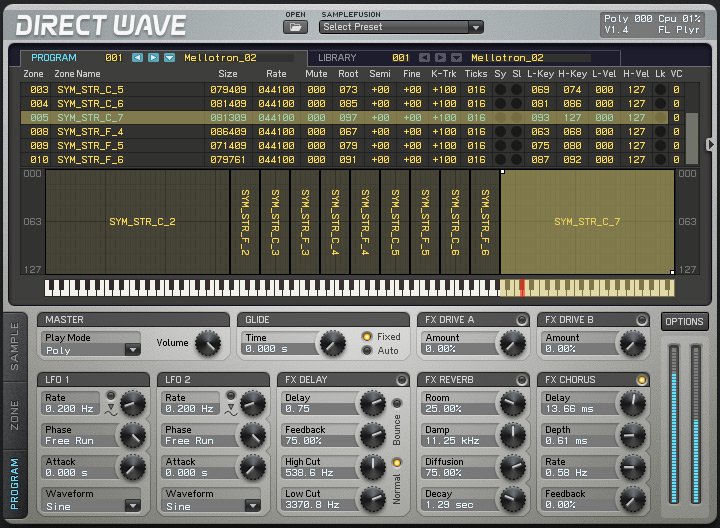
DirectWave is one of the most complete VSTi samplers currently available.


It loads and edits most of the existing sound formats out there (WAV (any), SF2 (Soundfont), AKP (Akai), Propellerheads Recycle, Native Instruments Battery, Kontakt *(nki), GIGA *(gig) & eMagic EXS24, ...) and it can even sample your existing VSTi instruments.


16 part multitimbral, 32-bit VSTi sampler

128 Voice Polyphony

128 programs

unlimited zones per program

All samplerates supported

Realtime SINC-64 point interpolation (HQ Audiophile)

Poly, Mono, Legato operation, with glide / auto mode.

2*24 dB 5 mode filters serial or parallel

Flexible 16 slot freely assignable Modulation Matrix

2 mod. ADSR envelopes, 2 zone-independent mod. LFOs 2 global program mod. LFOs

Automatable loop points, reverse loop points supported

Loop modes : fwd, one-shot, sustained, bounce looping

Automatable sample start offset (available as mod. destination parameters)

Built-in voice Insert FX with independent settings for each zone : ring mod. samplerate decimator, bitcrusher & phaser.

Built-in send effects : chorus, reverb, delay (with filtered feedback, sync to host tempo).

Independent send amounts per zone

Freely assignable 16 stereo outputs

Multi-editor with channel list, mixer, expression, modulation and pitchbend GUI controls

Built-in sample editor with destructive editing (cut / copy / paste / trim functions), loop finding tool, normalize, vertical / horizontal zooming, etc)

Realtime sampling / recording of whatever is connected to DirectWave inputs (needs modular host or host with assignable plug-in routing)

Record Threshold: sampling input will wait until signal peak arises (-40dB)

Built-in VSTi host to easily automate "sampling" of your vst instruments directly into DirectWave

Total Recall operation mode: DirectWave will enclose all the required sample data in the project files created by your host: it creates totally portable projects without worrying about needed sample files

Import: DWP (proprietary), WAV (any), SF2 (Soundfont), AKP (Akai), Propellerheads Recycle, Native Instruments Battery, Kontakt *(nki), GIGA *(gig) & eMagic EXS24

Several importing methods: built-in browsing, drag&drop, menu options

Built-in fast library browser list and tree-arranged menu program selector.

Zone editor with visual zone arrangement map and list with all zone properties

All program/zone parameters of all channels can be automated as VST parameters


DOWNLOAD

Image.Line.Sawer.VSTi.FLi.v1.0.3-Talula

Image and video hosting by TinyPic

Sawer is a vintage modeling synthesizer, that cuts through the mix to deliver precisely articulated and punchy sounds.

Sawer pays homage to the envelopes and filters of a rare 1980's Soviet analog synthesizer, Polivoks. Maxx has devoted meticulous attention to the detail of Sawer's filter and envelope designs, ensuring Sawer delivers a unique sonic character reminiscent of the Polivoks hardware. But Polivoks, like all analog synthesizers, wasn't without its problems. Keeping the oscillators stable and in tune has been likened to 'moving a pile of live frogs, by wheelbarrow', impossible! As Sawer is algorithmic, this solves the problems of tuning and stability, however, in the same way electrical component instability makes analog gear unique (if not cranky), Sawer benefits from the 21st century equivalent, a coding error.


While programming the SAW oscillator, Maxx accidentally set some incorrect variables and immediately the sound gained bass, acquired some light but pleasing noise on the attack and an overall richer sonic spectra. Maxx realized this was no mistake but a discovery and built on this, adding some frequency modulation to give it a touch of analog authenticity and so 'Sawer' was born.


Key features:


Main oscillator for subtractive synthesis: SAW shape with Sync frequency.

Sub oscillator (-2 to +2 octaves) with level, phase & detune controls.

1 NOISE Oscillator.

Variable polyphony (1 to 24 voices).

8 voice UNISON with user-adjustable stereo panning, detune and 'Octaver'.

SYNC & RING frequency modulation.

2 ADSR envelope generators (one user-assignable to modulation parameters).

4 FILTER modes - low pass (24 & 12 dB/Oct), band pass and high pass.

Chorus, Phaser, Delay & Reverb effects

Muti-mode Arpeggiator.


DOWNLOAD

Image.Line.Sakura.v1.0.1-UNION

Image and video hosting by TinyPic

Like the transient beauty of Sakura (Japanese for Cherry Blossom), the sound of stringed instruments blossoms and fades. Image-Line brings you ‘Sakura’, the string physical modelling instrument, to express the delicacy and beauty of stringed sounds.

Virtual modelling in Sakura follows a 5 stage hanami-process. :

Contact - An impulse, the mechanical contact with the string, is first generated then shaped to simulate plucks, picks, scrapes, hammers, taps or humble fingers.

Vibration - Sakura’s dual string model then gives the operator control over a wide range of parameters such as damping, tension, positioning and string properties.

String interaction – The dual strings are then mixed, panned and enveloped to simulate interactions.

Resonance - The string/s vibration then interacts with an 8-resonator ‘body simulator’ to create the size, material and shape of the instrument

Acoustics - Virtual acoustic space is then simulated with chorus, delay and reverberation effects.


Sakura can reproduce the delicate pluck of a single string, a violins bowing or the sonorous resonance of a grand piano. Most importantly, the curious musician can take control of every aspect of the simulation to create fantastic instruments. Ever wanted to know what a 20 foot guitar sounded like? Or a bowed piano? Now you can find out, Sakura opens up a world of string modelling possibilities, why not download the Sakura demo and try it for yourself. The Sakurazensen is coming, be there to experience it.


Terms

Sakura: Japanese for Cherry Blossom.

Hanami: The custom of enjoying the beauty of Sakura.

Sakurazensen: The Sakura-front as it moves across Japan with the developing season.


DOWNLOAD

Image.Line.PoiZone.v2.2.6-UNION

Image and video hosting by TinyPic
PoiZone is a subtractive software synthesizer designed to bring you professional quality results, without a learning curve that hinders your creativity. The concept behind PoiZone was to design a synthesizer that had the smallest number of controls while providing the maximum flexibility and features.

Useless knobs were ruthlessly removed so what remains is a UI where every knob counts. Once you have spent some time auditioning the preset patches we are sure you will agree that PoiZone packs a lot of punch in what appears to be a simple package, enjoy!

Features :

2 oscillators that can produce the two most popular and useful shapes for subtractive synthesis: fat, bright SAW and PULSE shapes, with adjustable pulse width.

Noise generator.

Ring modulation

Sync modulation

16 voice polyphony

4 voice UNISON with user-adjustable stereo panning and 'Octaver'. The Octaver expands the harmonic range and flexibility of the unison sound to support the creation of realistic 'vox-like' effects

2 ADSR envelope generators. One for traditional envelope duties, the other can be user assigned

3 FILTER modes - low pass, band pass and high pass. PoiZone features a warm, super-trooper-extra-analog-moog-like-mega filter with self oscillation. Special attention has been given to precise filter tuning so that when KEYTRK is set to maximum, the PoiZone filter will track keyboard frequency precisely so it can be used as an oscillator. The PoiZone filter has bright and clean sound or it can be 'grungy' and 'angry' when resonance is introduced as it features some light distortion. And even with distortion the filter sounds clean on high frequencies as it has no aliasing

Keyboard and Velocity tracking for the filter

Multi-mode Arpeggiator

Noise Gate with an adjustable 16 step pattern. The gate features smoothness control and the ability to import/export patterns to .fxp files

DELAY effect, with tempo-synced click-free stereo delays and delay time modulation. Lo-cut and hi-cut for trancers!

CHORUS with a warm sound with great unison emulation

MIDI learn feature with the ability to save/load MIDI setups to/from a patch

LFO and MOD WHEEL modulation. Can be assigned to a wide range of performance parameters in PoiZone


DOWNLOAD